
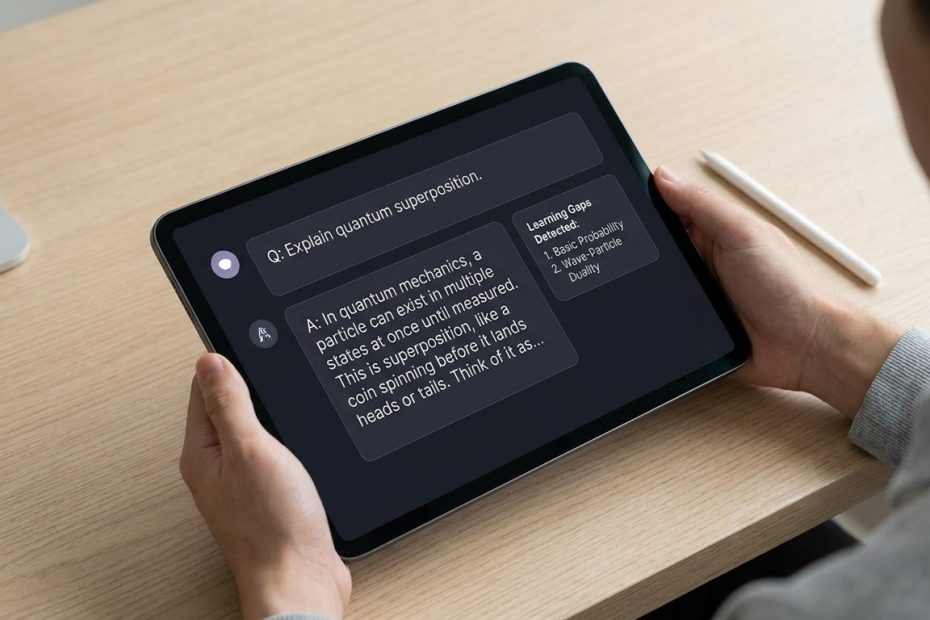
You can use Artificial Intelligence (AI) to test understanding by making it question, challenge, and evaluate your reasoning before it provides an explanation. The best checks require you to retrieve the concept from memory, explain it in plain language, and apply it to an unfamiliar problem.
Reading a clear explanation can make a topic feel familiar without proving that you understand it. A generative AI study assistant helps expose that gap when you treat it as a questioning partner rather than an answer machine. The methods below show you how to test comprehension, uncover misconceptions, and verify feedback without becoming dependent on the tool.
Why Does Familiarity Feel Like Understanding?
Familiarity feels like understanding because recognizing information is easier than retrieving and using it. You can follow a textbook paragraph or lecture and still struggle to explain the main idea without looking at the source.
This false confidence often appears after repeated reading. The words become familiar, so your brain interprets smooth reading as evidence of learning. Close the book, remove the notes, and the difference becomes visible: Can you define the concept, connect its parts, and explain why it works? If the explanation breaks down, you’ve found a learning gap rather than a failure.
Retrieval practice offers a better check than another round of reading. Research on test-enhanced learning shows that recalling information can support longer-term retention more effectively than repeated study alone. Practice testing also ranks among the better-supported learning techniques examined in cognitive and educational psychology. AI makes retrieval practice easier to organize, but you still need to produce the answer before seeing assistance.
What Can AI Check, and What Can’t It Check?
AI can examine your explanation for missing steps, vague terms, unsupported assumptions, and internal contradictions. It can’t guarantee that its evaluation or replacement explanation is accurate.
An AI tutor can ask follow-up questions, compare two definitions, generate application tasks, and point out where your reasoning becomes unclear. It can also adjust the difficulty after seeing your response. These functions make it useful as a metacognitive mirror: the conversation shows what you can retrieve and where you depend on hints. Your own performance supplies the strongest evidence of understanding.
Generative AI can also produce plausible errors, invented details, and faulty explanations. Treat any factual correction as a claim that needs verification, especially in technical, medical, legal, or calculation-based material. Compare disputed feedback with your textbook, lecture notes, assigned readings, or another trusted reference. AI can reveal where to review, but it shouldn’t serve as the sole judge of accuracy.
How Can You Use AI to Test Understanding Without Getting Answers Too Soon?
Tell the AI to ask one question at a time, wait for your response, and withhold answers until you’ve made a full attempt. This turns the session into active recall rather than assisted reading.
A weak request sounds like, “Explain photosynthesis.” That request produces more material to read, which can strengthen familiarity without testing recall. A better instruction controls the sequence and prevents early hints. Use a prompt like this:
Prompt: “Act as a strict tutor for [concept]. Ask one open-ended question at a time. Wait for the learner’s full answer before responding. Do not reveal the answer or provide hints unless two attempts have been made. After every response, identify one accurate point, one gap, and one follow-up question.”
Answer without checking your materials. If you get stuck, describe the exact point where your reasoning stops instead of asking for the solution. That pause is useful evidence because it identifies the boundary of your knowledge. Review the source only after the AI has documented the gap.
How Can Socratic Questions Expose Gaps in Your Reasoning?
Socratic questioning tests the reasons behind your answer rather than checking whether you can repeat a definition. It pushes you to defend assumptions, predict outcomes, and connect causes with effects.
Start by giving the AI a short explanation in your own words. Ask it to respond only with questions that examine your reasoning. Strong follow-ups include: “Why does that step follow?”, “What assumption does that claim depend on?”, “When would this rule fail?”, and “What evidence would change the answer?” These questions make vague knowledge harder to hide.
Prompt: “Use Socratic questioning to evaluate the explanation below. Do not rewrite it or give the correct explanation yet. Ask one question at a time about definitions, causes, assumptions, exceptions, and consequences. Continue until the learner can defend every major claim or identifies a gap.”
Pay attention to repeated dependence on broad words. Terms like “process,” “factor,” “system,” and “thing” can conceal a missing mechanism. Ask the AI to flag any sentence that sounds correct but lacks a precise relationship between ideas. Then replace general language with a clear statement of what changes, why it changes, and under which conditions it changes.
How Do You Use the Feynman Technique With AI?
Explain the concept in plain language, let the AI identify weak or missing steps, then revise the explanation without copying its wording. The goal is to make your reasoning simpler and more precise, not merely shorter.
Begin with a closed-book explanation intended for someone who hasn’t studied the subject. Define necessary terms and connect each step to the one before it. Avoid copying memorized phrases that you can’t unpack. If a technical term is necessary, explain what it means and what job it performs within the concept.
Prompt: “Evaluate this plain-language explanation of [concept]. Mark unclear terms, missing causal steps, hidden assumptions, and statements that may be inaccurate. Ask the learner to repair each issue before showing a model explanation. Do not praise the response unless the reasoning supports the praise.”
After receiving feedback, write a fresh explanation from memory. Don’t edit the original sentence by sentence because that can turn the task into copying. Compare the revised version with your trusted source and record any remaining gaps. Repeat the exercise later to check whether the explanation survives after the material is no longer fresh.
How Can AI Generate Practice Problems and Edge Cases?
Ask AI to create problems that require transfer, comparison, prediction, and error diagnosis. These tasks reveal whether you can apply the concept beyond the wording used in your notes.
A definition question tests basic recall, but an application problem tests whether you recognize when the idea matters. Request a familiar problem, an unfamiliar problem, and a case where the concept does not apply. You can also ask for two similar situations with different correct answers. Explaining why the answers differ gives you a stronger comprehension check than selecting an option.
Prompt: “Create three original practice problems about [concept]: one direct application, one unfamiliar application, and one edge case where a common rule fails. Present one problem at a time. Require a full explanation, score the reasoning against stated criteria, and delay the solution until the learner has revised the answer once.”
Ask the AI to vary the surface details without changing the underlying principle. If you can solve only problems that resemble the textbook, you may have memorized a pattern rather than understood the idea. Include error-analysis tasks where the AI presents flawed reasoning and asks you to diagnose it. Finding and repairing an error requires you to distinguish a valid step from a convincing imitation.
How Do You Prevent False Confidence From AI Feedback?
Require specific evaluation criteria, ask the AI to challenge your answer, and verify factual corrections against trusted material. General praise doesn’t prove that your explanation is accurate or complete.
AI tools often produce agreeable responses when instructions are vague. A comment like “Great explanation” has little value unless it identifies which claims were accurate and which standards were met. Ask for a line-by-line review based on factual accuracy, causal reasoning, terminology, exceptions, and application. Require the tool to quote the exact sentence that needs revision before describing the problem.
Prompt: “Evaluate the response as a skeptical examiner. Separate the review into accurate claims, unsupported claims, missing steps, incorrect claims, and unclear wording. Give a confidence label for every correction and mark any point that requires checking against a trusted source. Do not provide a passing judgment based on writing quality alone.”
Watch for warning signs in the feedback. These include unsupported certainty, invented references, inconsistent explanations, and corrections that conflict with assigned material. Recheck calculations independently and confirm specialized claims in the source your course or workplace recognizes. If the AI and trusted material disagree, use the disagreement as a review target rather than assuming the AI is right.
What 15-Minute Workflow Can Verify Your Understanding?
A short comprehension check should combine closed-book retrieval, targeted questioning, application, and source verification. Fifteen focused minutes can show whether you need another study session or can move to harder material.
Minutes 1 to 3: Write a plain-language explanation without notes. Minutes 4 to 7: ask AI to identify gaps and deliver Socratic follow-up questions. Minutes 8 to 11: solve one unfamiliar application problem and explain every step. Minutes 12 to 15: compare disputed points with your textbook or notes, then record what needs review.
Keep the source material separate until the retrieval stage ends. Paste only the portions needed for comparison, and remove private, confidential, or personally identifying information. If your school or employer limits AI use, follow those rules and use the tool for permitted self-testing rather than graded work. Academic honesty is easier to maintain when you produce the initial response yourself and use AI for questions and feedback.
Repeat the check after a delay instead of relying on one successful session. Distributed practice tests whether the idea remains accessible after short-term familiarity fades. Save the questions you missed and revisit them during later study sessions. When using AI to test understanding, measure progress by the quality of your independent explanations, not by the length of the conversation.
How Can You Use AI to Test Your Understanding of a Concept?
- Ask AI to quiz you with open-ended questions.
- Explain the concept in your own words and request gaps.
- Request Socratic follow-up questions.
- Generate practice problems that require application.
Make AI Prove What You Can Do Without It
Real understanding appears when you can retrieve an idea, explain its parts, apply it under new conditions, and correct flawed reasoning without depending on immediate hints. AI can create those tests quickly, but your independent response remains the evidence that matters. Make the tool ask before it answers, demand specific feedback, and verify corrections with trusted materials. Use AI to test understanding after studying, then repeat the check after enough time has passed for familiarity to fade. If you can still explain and apply the concept accurately, you’ve moved beyond recognition into usable knowledge.
References
- Roediger and Karpicke, Test-Enhanced Learning: Taking Memory Tests Improves Long-Term Retention
- Dunlosky and colleagues, Improving Students’ Learning With Effective Learning Techniques
- The Learning Scientists
- Retrieval Practice.

Nirdosh Jagota is Managing Partner at GRQ Biotech Advisors with 30+ years in the biotech industry. A former executive at Amgen, Genentech/Roche, Merck, and Pfizer, he has led >25 NDAs/BLAs/MAAs and hundreds of INDs across global regulatory, quality, and compliance.